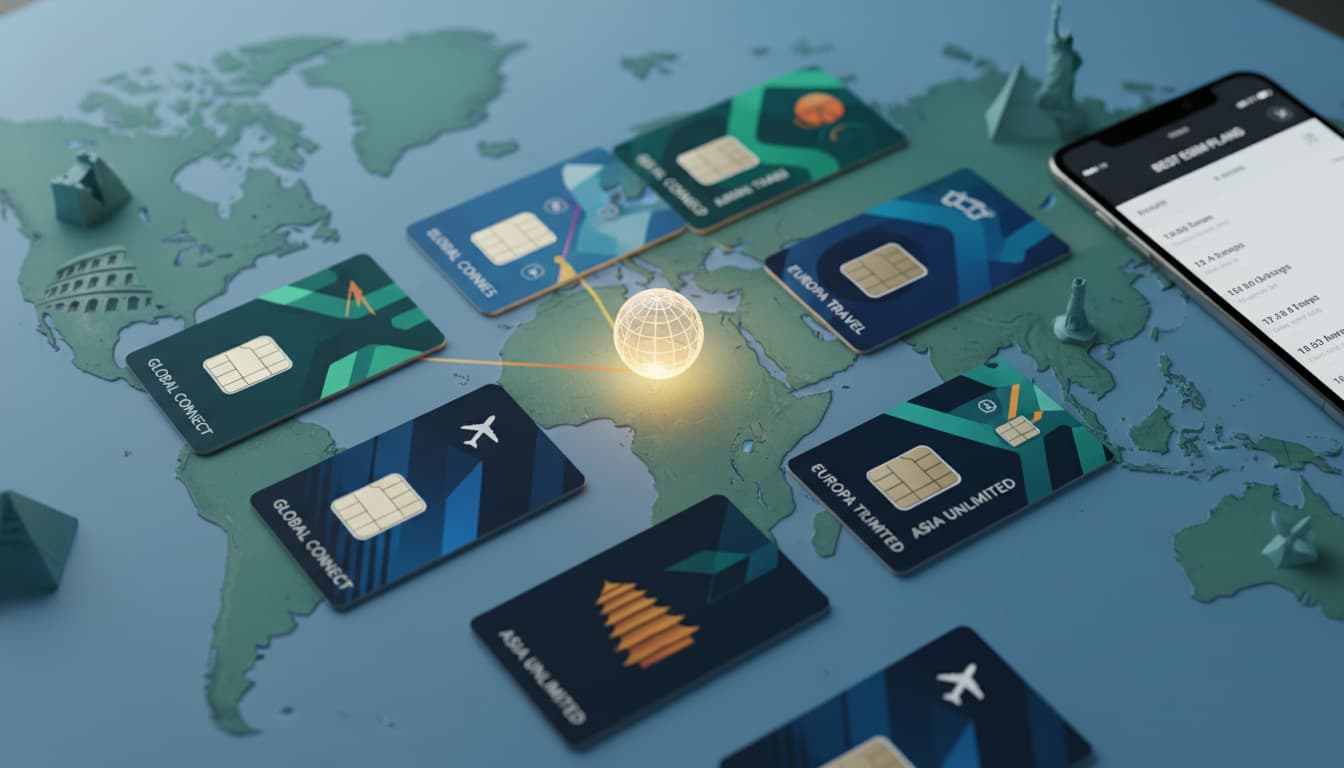

In brief, what you’ll discover in this article: how to choose the best travel eSIM suited to your needs, a comparison of major providers, key criteria for optimal mobile connectivity abroad, as well as practical tips for activation and security.
1. Introduction: Why Choose an eSIM for Traveling
The travel eSIM revolutionizes how travelers stay connected abroad. Unlike a physical SIM card, it offers instant activation without waiting or visiting a store. This technology makes mobile internet access easier in over 200 countries while reducing roaming fees. For travelers, the international eSIM card means freedom and simplicity, avoiding the hassle of buying multiple local SIMs.
2. What is an eSIM?
2.1 Definition and Technical Principle
An eSIM is a chip embedded directly in your smartphone, capable of storing multiple carrier profiles. It allows you to download a mobile plan remotely without a physical card. This technology is compatible with many recent smartphones, simplifying the management of international plans.
2.2 Differences from a Physical SIM
Unlike a standard SIM, the eSIM requires no manual insertion. It offers greater flexibility since you can change operator or plan without swapping cards. It also eliminates risks of loss or damage associated with physical SIMs.
To better understand the basics, check out our comprehensive article on what an eSIM is.
3. Advantages and Limitations of the eSIM for Travel
3.1 Advantages: Activation, Savings, Flexibility
eSIM activation is almost instantaneous via a QR code or dedicated app, greatly simplifying travel preparations. Travel eSIM plans are often more economical than classic roaming plans, with options suited for every budget. Plus, the flexibility lets you choose between data-only plans or those including calls, depending on your needs.
3.2 Limitations: Compatibility, Carrier Lock, Dual SIM Usage
However, smartphone eSIM compatibility remains a key consideration before purchase, as not all models support this technology yet. Some devices might be carrier locked, limiting eSIM use. Finally, managing dual SIMs can sometimes be complex depending on the brand.
4. How to Choose the Best eSIM for Your Trip
4.1 Essential Criteria: Coverage, Price, Data vs Duration, 5G
To select the best travel eSIM, compare network coverage abroad, price, and data volume offered. Having 5G support is a plus for demanding travelers. It’s also important to check the plan’s validity period and ease of top-up.
4.2 Device Compatibility: List and Checks Before Departure
Before subscribing, verify your smartphone’s compatibility with eSIMs. Recent iPhone, Samsung, Google Pixel, and some Huawei models are supported. Consult the official supported device list to avoid surprises.
4.3 Customer Support, Refund Policy, and Transparent Pricing
A good eSIM provider should offer responsive customer support, clear refund policies, and transparent pricing without hidden fees. These factors ensure a hassle-free experience if issues arise.
4.4 Traveler Profiles and Personalized Recommendations
Depending on your profile, some offers will better suit you:
- Nomadic traveler: favor flexible, multi-destination plans like Ubigi or Saily.
- Tight budget: Yesim offers economical options.
- Enhanced security: Saily includes a VPN to protect your data.
- Long stays or heavy use: Holafly provides unlimited plans in over 270 countries.
5. Comparison of Top Providers (Practical Sheets)
5.1 Airalo — Strengths / Limitations / Pricing
Airalo is known for affordable prices and wide coverage. Its travel eSIM plans offer local, regional, or global options starting at €4.50. Activation is simple via their app, though data volumes tend to be limited.
5.2 Holafly — Strengths / Limitations / Pricing
Holafly stands out with unlimited plans in 258 countries, perfect for long stays. Prices are higher (for example: €44.90 for 14 days in Asia), but ease of use and broad coverage compensate. Holafly is ideal for travelers seeking peace of mind.
5.3 Saily — Strengths / Limitations / Pricing
Saily combines coverage in over 200 countries with a built-in VPN, ensuring security and privacy. Plans start at €3.99 for 1GB, with remarkable flexibility. It’s the best travel eSIM for those who want connectivity plus data protection.
5.4 Ubigi and Other Alternatives
Ubigi offers a flexible plan tailored for nomads, with plans starting at €2.90. Its network is reliable, especially in Europe and North America. Other alternatives like Nomad complete the market with options for short stays.
For a detailed overview, find our complete travel eSIM comparison.
6. Plans and Use Cases: Data-only vs Voice / Local Number
6.1 When to Choose a 100% Data Plan
A 100% data eSIM plan suits travelers primarily using messaging apps, navigation, and streaming. It is often cheaper and easier to manage.
6.2 Options with Local Number and Calls
For those who want to receive local calls or use a local number, some providers offer plans including voice and SMS. This option is useful for business trips or long stays.
7. Installation and Activation Guide Step-by-Step
7.1 Prepare Your Device Before Departure
Make sure your smartphone is compatible and updated. Disable mobile data before activation to avoid unexpected charges.
7.2 Activation via QR Code / App / Detailed Steps
Activation usually involves scanning a QR code provided after purchase or using a dedicated app. Follow instructions to add the eSIM profile to your phone.
7.3 Troubleshooting Common Issues (Activation Failure, No Network)
If activation fails, check compatibility, local network coverage, and restart your device. Contact customer support if needed.
For a complete tutorial, see our guide on how to install an eSIM.
8. Advanced Features and Tips
8.1 Built-in VPN and Data Security While Traveling
Some eSIMs like Saily include a VPN, ensuring the confidentiality of your communications — a major asset for security-conscious travelers.
8.2 Managing Multiple eSIMs / Dual SIM and Switching Optimally
Dual SIM-compatible smartphones can manage multiple eSIMs simultaneously. Learn to switch between them to optimize your connection depending on the country.
8.3 Taking Advantage of Promotions and Optimizing Cost per GB
Watch seasonal promotions and compare price per GB to maximize your budget. Some providers offer discounted top-ups.
9. Performance Tests and Real Coverage
9.1 Testing Methodology (Speed, Latency, Roaming)
Tests measure connection speed, latency, and network stability in real conditions — essential to evaluate an eSIM’s quality.
9.2 Results by Typical Destination
Performance varies by country and local operators. Holafly and Saily show solid coverage in Asia and Europe, while Ubigi performs well in America.
10. Conclusion and Quick Recommendation by Profile
In conclusion, the best travel eSIM depends on your profile and needs. For secure, multi-country use, Saily is an excellent choice. Budget travelers will appreciate Yesim, while Holafly impresses with unlimited plans. Don’t forget to verify your smartphone’s compatibility and prepare activation before departure for a smooth experience.
For deeper insights, explore our other guides on Skyda.co and gear up confidently for your next connected trip.