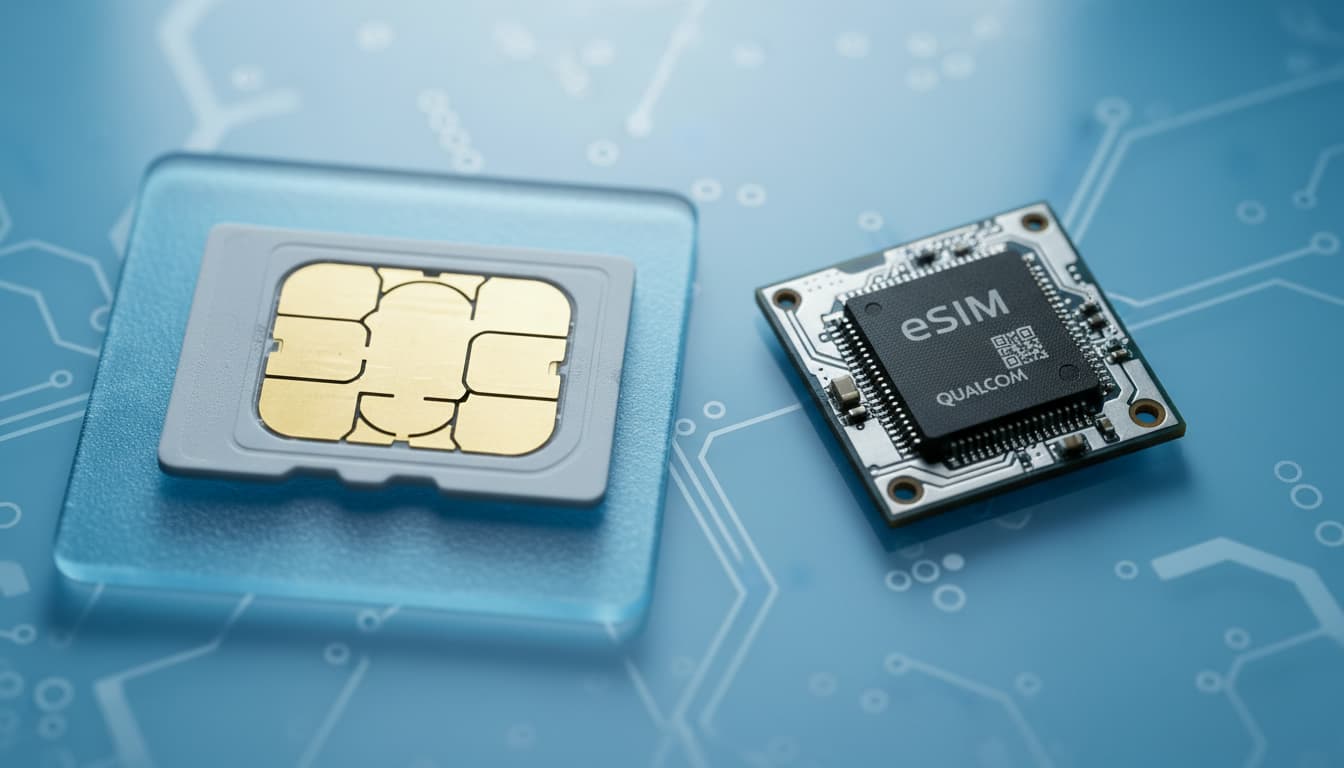

In short, what you'll learn in this article: the difference esim sim card explained simply, focusing on technical, functional, and practical aspects. You'll know how to choose between a physical SIM card and an embedded eSIM based on your needs, phone, and usage.
1. Introduction — why compare eSIM and physical SIM card
Comparing the physical SIM card and the eSIM is essential to understand how these technologies influence your mobile experience. This comparison will help you determine if the eSIM really changes anything for your phone or plan, and if it meets your expectations in terms of simplicity, security, and compatibility.
2. What is a physical SIM card?
2.1 Technical operation and formats (mini/micro/nano)
The physical SIM card is a removable chip inserted into a phone. It comes in several formats: mini, micro, and nano, suited to different devices. This card contains subscription information and allows identification on the mobile network.
2.2 Activation and typical usage
Activation of the physical SIM is usually done by inserting it into the phone, followed by an automatic or manual setup depending on the operator. Usage is simple: it stays in the device until a plan or phone change occurs, often requiring a store visit to get a new card.
3. What is an eSIM?
3.1 Technical principle (remote profile, OTA provisioning)
The eSIM is an embedded eSIM directly soldered onto the phone’s motherboard. It operates via a digital profile downloaded remotely through a process called OTA provisioning (Over The Air). This avoids physically handling a card, making the phone thinner and waterproof.
3.2 Activation (QR code, operator app, eSIM management)
To activate an eSIM, you often just scan a QR code provided by the operator or use a dedicated app. Managing eSIM profiles is simplified, allowing you to add, delete, or change plans without swapping physical cards — all remotely.
4. Key differences between eSIM and SIM card
4.1 Format and physical presence
The main difference lies in the format: the physical SIM is a removable card, whereas the eSIM is embedded and invisible. This integration allows more compact designs and better water resistance.
4.2 Activation and portability
Activating a physical SIM requires manual handling, often in-store, while the eSIM activates instantly via QR code or app. Portability is smoother with the eSIM, easing switching operators or plans.
4.3 Multi-number management and dual-SIM
The eSIM supports multiple profiles, with the ability to activate two simultaneously — ideal for managing personal and work lines. The physical SIM is limited to one number per card unless the phone has a dual slot.
4.4 Security and protection against theft/cloning
Security is enhanced with the eSIM, as it's hard to steal or clone. Remote management also lets you block or delete a profile quickly, unlike physical SIMs which can be lost or copied.
4.5 Device compatibility and limitations
eSIM compatibility is still limited to recent smartphones, tablets, and smartwatches. Conversely, the physical SIM remains universal and works with most devices, including older models.
5. Advantages and disadvantages (summary comparison table)
| Criterion | Physical SIM Card | Embedded eSIM |
|---|---|---|
| Format | Removable card (mini/micro/nano) | Chip embedded on the motherboard |
| Activation | Manual insertion, store visit | Digital activation via QR code or app |
| Multi-profile management | Limited, one number per card | Multiple profiles, 2 active simultaneously |
| Security | Risk of theft/cloning | Enhanced security, hard to clone |
| Compatibility | Universal, all devices | Limited to recent devices |
| Design | Requires physical slot | Allows thinner, waterproof designs |
| Cost | Usually included in plans | Sometimes extra fees by operators |
6. Recommended use cases
6.1 Travelers and tourists
The eSIM is ideal for travelers as it allows quick activation of a local plan without changing SIM cards, easing roaming and managing local data. Learn more with the best eSIM for travel.
6.2 Professional users and IoT
Professionals appreciate simplified multi-number management with the eSIM, which separates personal and work lines on one device. Additionally, eSIM powers many connected IoT devices for reliable connectivity.
6.3 General users (simplicity vs control)
For everyday use, the physical SIM remains simple and compatible with all phones. The eSIM offers more flexibility and security but requires a compatible device and an operator offering the service.
7. How to switch from a SIM card to an eSIM — detailed procedure
7.1 Preparation before migration (backup, operator checks)
Before migrating, back up your contacts and verify that your phone supports eSIM. Contact your operator to confirm eSIM availability and transfer conditions.
7.2 Activation steps (operator examples / screenshots)
- Request a QR code or activation link from your operator.
- On your phone, go to SIM management settings.
- Scan the QR code or follow the operator app instructions.
- Activate the eSIM profile and disable the physical SIM if needed.
For a full guide, see our article on how to install an eSIM.
8. Common issues and solutions (troubleshooting)
- Activation problem: check device compatibility and QR code validity.
- Network problem: restart the phone or reactivate the eSIM profile.
- Multi-profile management: ensure you don't exceed the maximum stored profiles.
9. Conclusion and practical recommendations
The difference esim sim card lies in the flexibility, security, and modernity of the eSIM versus the simplicity and universal compatibility of the physical SIM. For a futuristic, mobile lifestyle, the eSIM is a smart choice. Feel free to deepen your understanding of eSIM with our dedicated article on what is an eSIM.
To stay ahead, also explore the best eSIM offers and learn to secure your mobile connection with suitable VPN solutions.