
In brief, what you will discover in this article: the precise definition of the ellipse in physics, its fundamental geometric properties, as well as its key applications in celestial mechanics and optics. You will find a clear and accessible explanation, ideal for understanding this concept often encountered in classes or presentations.
1. Introduction — why define the ellipse in physics
The ellipse is an essential geometric curve in physics, especially for describing natural phenomena like planetary trajectories. Understanding the definition of the ellipse in physics helps to grasp key concepts such as elliptical orbits or wave focusing. Although mathematical, this notion lies at the heart of many physical laws, notably Kepler's law.
2. Geometric definition of the ellipse
2.1 Construction by foci and constant sum of distances
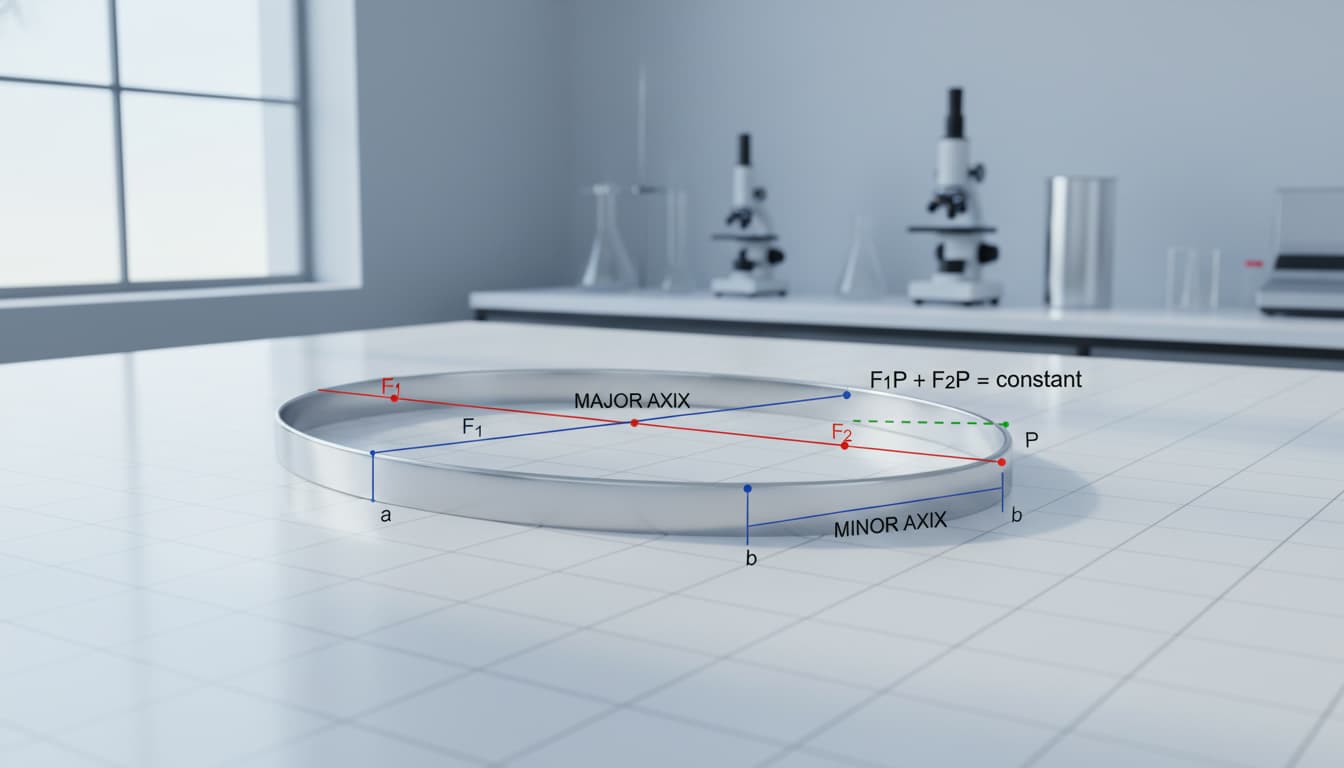
An ellipse is defined as the set of points whose sum of distances to two fixed points called foci is constant. This bifocal property is the basis for visualizing the curve.
2.2 Terminology: foci, major axis, minor axis, eccentricity
- Foci (F₁ and F₂): fixed points inside the ellipse.
- Major axis (2a): the longest segment passing through the foci.
- Minor axis (2b): segment perpendicular to the major axis at the center.
- Eccentricity (e): measure of flattening, defined by e = c / a where c is the distance from the center to the foci.
These elements are essential to describe the geometry of the ellipse, which appears in many physical applications.
3. Algebraic definition and equation
3.1 Standard Cartesian equation and parameters
The ellipse can be represented by the standard Cartesian equation:
(x^2) / (a^2) + (y^2) / (b^2) = 1
where a and b are the semi-major and semi-minor axes respectively. This form is used to precisely calculate points on the curve.
3.2 Conversion between forms (canonical, parametric)
The parametric equation of the ellipse is written:
x = a * cos(t), y = b * sin(t)
with t ranging from 0 to 2π. This representation facilitates modeling periodic motions and elliptical trajectories.
4. Geometric properties useful in physics
4.1 Relationship between eccentricity and axes
The eccentricity e relates the focal distance c to the axes by the relation:
c^2 = a^2 - b^2
This property allows evaluating the shape of the ellipse, essential for understanding trajectories in celestial mechanics.
4.2 Reflection properties and trajectories
A remarkable property is that rays originating from one focus reflect by passing through the other focus. This characteristic is exploited in optics, notably in elliptical mirrors.
5. Applications in physics
5.1 Celestial mechanics — elliptical orbits and Kepler’s laws
Planets follow elliptical trajectories around the Sun, located at one of the foci, according to Kepler’s law. This fundamental law explains the variation in orbital speed and the shape of orbits.
5.2 Optics — focusing and elliptical mirrors
In optics, the ellipse is used to design mirrors and lenses that concentrate light or acoustic waves between the foci, thus improving instrument precision.
5.3 Other examples: trajectories, vibrations, practical uses
The ellipse also appears in the study of mechanical vibrations, particle trajectories, or in some electronic systems where geometry influences behavior.
6. Illustrations and tools
6.1 Graphs, animations and interactive calculator
To better visualize the ellipse, interactive tools allow manipulating the parameters a, b, and e, and observing shape changes in real time. These resources aid intuitive understanding.
6.2 Step-by-step numerical examples
A simple example consists in calculating the foci of an ellipse with a=5 and b=3:
- Calculate c = sqrt(a^2 - b^2) = sqrt(25 - 9) = 4.
- Position the foci at ±4 on the x-axis.
- Verify that for any point M on the ellipse, the sum MF1 + MF2 = 2a = 10.
7. Worked exercises and typical problems
To deepen your knowledge, practicing with exercises involving:
- Determining the foci from the axes.
- Verifying the bifocal property.
- Applying the Cartesian equation to given points.
These exercises strengthen concept mastery and prepare for more complex applications.
8. Conclusion — summary and ways to explore further
The ellipse, through its simple yet rich geometric definition, plays a central role in physics, especially in celestial mechanics and optics. Understanding the characteristics of the ellipse helps in grasping natural and technological phenomena. To go further, exploring links between the ellipse and other conic curves or deepening its astrophysical applications is recommended.
For an accessible and visual introduction, the resource Khan Academy on the ellipse is ideal.
Moreover, if you want to understand how eSIM technology is revolutionizing connectivity, discover our comprehensive guide on what is an eSIM to stay connected even on the go.
Finally, to fully enjoy your eSIM, feel free to consult our practical article on how to install an eSIM, a perfect complement to master this technology.
Recommended affiliate links:
- To secure your mobile connection while traveling, discover the best VPN apps compatible with eSIM.
- Enjoy exclusive offers on international eSIM plans to stay connected hassle-free.