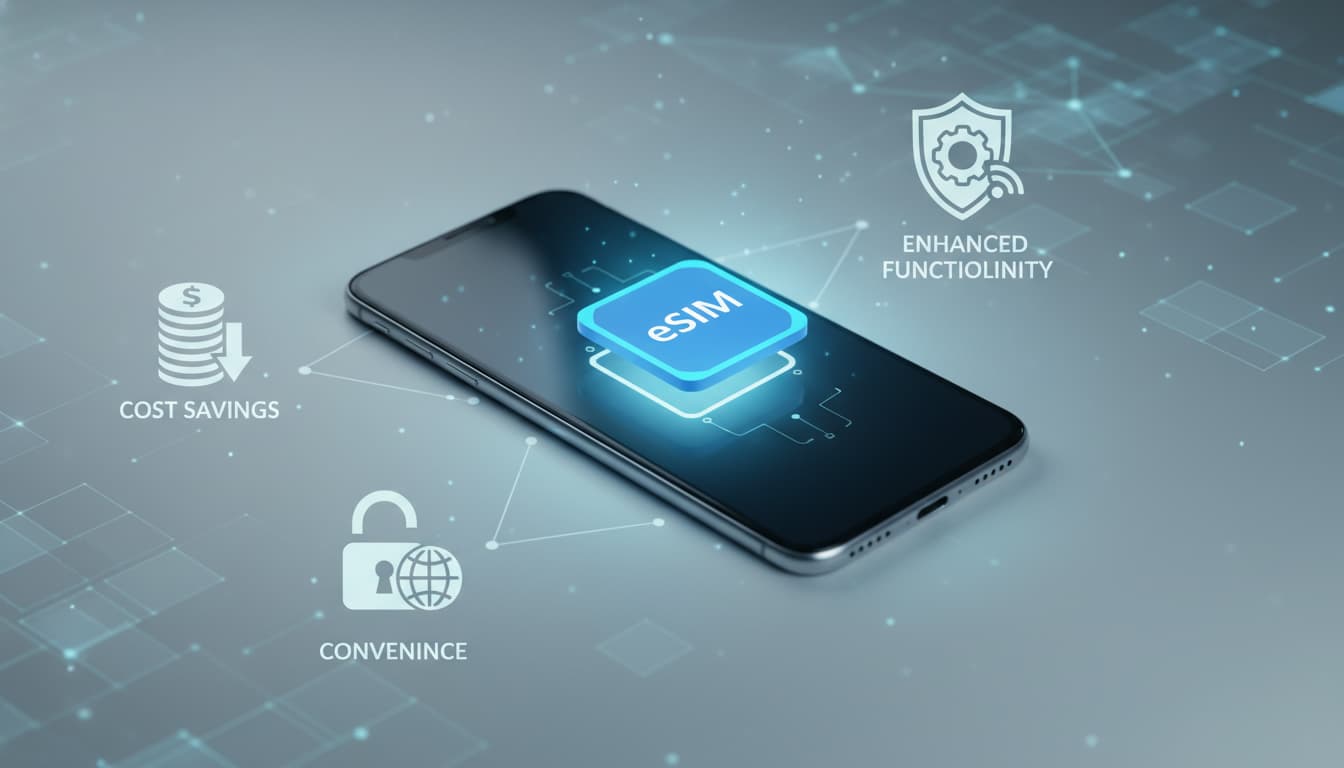

In short, what you will learn in this article: why eSIM is often considered more advantageous than a traditional SIM card, its benefits in terms of convenience, costs, and security, as well as tips to choose and use this innovative technology well.
1. Introduction: Why pay attention to eSIM and the key question "Is eSIM more advantageous?"
eSIM is a revolution in the world of mobile telephony. Compared to the classic SIM card, it promises more flexibility, simplified activation, and potential savings. But is it really more advantageous for all types of users? This guide will help you understand the major differences, concrete benefits, and limits to consider before taking the leap.
2. What is eSIM?
2.1 Technical definition and how it works
The eSIM, or embedded SIM, is a chip integrated directly into the smartphone or connected device. Unlike the physical SIM card, it does not require manual insertion. The operator profile is installed via a secure download, often by QR code or through a dedicated app. This digital process allows smoother management of mobile subscriptions.
For a clear and complete definition, you can consult this guide on what an eSIM is.
2.2 Difference between eSIM and physical SIM
The traditional SIM card is a removable chip inserted into the phone. It takes up physical space and can be damaged or lost. The eSIM, on the other hand, is embedded, freeing up space in the device and improving its design (waterproofing, compactness). Moreover, the eSIM can hold multiple profiles simultaneously, which is impossible with a classic SIM.
3. Advantages of eSIM (overview)
3.1 Flexibility and multi-profiles (personal/pro, travel)
One of the biggest advantages of eSIM is its ability to manage multiple profiles. You can have both a personal and a professional line on the same device, or multiple plans for different countries. This flexibility is ideal for frequent travelers and multi-line users.
3.2 Simplified activation and portability
With eSIM, activation is instant and digital. No need to wait for a physical card or visit a store. Changing operators can be done in just a few clicks, directly in the phone settings, greatly facilitating portability.
3.3 Potential savings (roaming fees, local plans)
eSIM allows avoiding high roaming costs by subscribing to a local digital plan while traveling. This ability to quickly switch offers reduces unnecessary expenses. Furthermore, some operators propose eSIM plans at transparent prices with no hidden fees.
3.4 Security and remote updates
eSIM's security is enhanced thanks to the possibility to disable or modify a profile remotely in case of loss or theft. It is also less vulnerable to cloning than a physical SIM. Updates can be performed without physical intervention, ensuring better protection.
4. Disadvantages and limits to know
4.1 Device compatibility
Not all smartphones are yet compatible with eSIM. It is important to check your device’s eSIM compatibility before committing.
4.2 Operator lock-in and contractual constraints
Some operators may limit eSIM use or impose contractual restrictions. Therefore, it is essential to compare offers carefully and ask the right questions before purchasing.
4.3 Scenarios where physical SIM remains preferable
In certain cases, especially for older devices or when a physical card is needed for specific use, the traditional SIM remains the better option.
5. Practical comparison: eSIM vs physical SIM card
5.1 Cost (purchase, subscriptions, roaming)
| Criterion | eSIM | Physical SIM card |
|---|---|---|
| Purchase | Often included in plan | Sometimes paid separately |
| Subscriptions | Flexible plans, no activation fees | Classic plans |
| Roaming | Easy to activate local plans | High roaming costs |
5.2 Ease of use (activation, changing operator)
eSIM activates via QR code or app, with no waiting or store visit. Changing operator is instant. Physical SIM requires a new card and manual handling.
5.3 Reliability and recovery in case of issues
Physical SIM can be easily replaced in store. eSIM can be reactivated remotely, avoiding losses or damage related to physical cards.
6. Detailed use cases
6.1 Frequent travelers and tourists
eSIM is ideal for travelers who want to quickly change plans without searching for a local store. It also allows combining multiple plans for different countries, reducing costs.
6.2 Dual-SIM users (work/personal)
Professionals wanting to separate private and professional life fully benefit from the multi-profile management offered by eSIM.
6.3 Businesses and IoT
Companies use eSIM to remotely manage fleets of connected devices, especially in the Internet of Things, thanks to its flexibility and security.
7. How to choose an eSIM (checklist)
- Verify your device’s eSIM compatibility.
- Compare operators offering eSIM based on coverage, prices, and customer support.
- Ask questions about portability, termination, and possible limitations.
- Evaluate your needs in multi-profiles and mobility.
- Consider security aspects and ease of activation.
8. Step-by-step activation guide
8.1 Prepare your device and backups
Before activating an eSIM, back up your data and make sure your device is up to date.
8.2 Activation steps (QR, operator app, OTA)
Activation is generally done by scanning a QR code provided by the operator or via a dedicated app. Some devices also support OTA (Over The Air) activation.
8.3 Troubleshooting common issues
If there’s a problem, restart your device, check internet connection, and contact operator support. For more details, see our comprehensive guide on how to install an eSIM.
9. Practical and legal aspects
9.1 Identification, locking, and number transfer
eSIM follows the same identification rules as conventional SIM. Number portability is possible but depends on the operators.
9.2 Privacy & security of eSIM profiles
eSIM profiles are encrypted and protected, offering a higher security level than physical SIMs, particularly against theft or cloning.
10. Conclusion: When is eSIM really more advantageous?
eSIM is clearly more advantageous for those seeking flexibility, ease of use, and savings, notably while traveling or managing multiple lines. However, compatibility and some contractual constraints may limit its use. For most modern users, eSIM represents a major technological advancement to embrace.
To deepen your understanding, feel free to check the detailed comparison on eSIM vs SIM card highlighting the concrete benefits of eSIM.
To fully enjoy this technology, download our complete checklist and explore our eSIM offer comparator on skyda.co.
Key benefits of eSIM:
- Instant activation without store visit
- Multi-profile management on a single device
- Savings on roaming fees
- Enhanced security and remote updates
- Reduced ecological impact (no plastic)
Steps to choose your eSIM well:
- Check your smartphone’s compatibility
- Compare eSIM operator offers
- Assess your mobility and multi-line needs
- Ask the right questions about contract terms
- Prepare activation and profile management
Recommended affiliate links to subscribe to an eSIM:
- Holafly eSIM plans: unlimited data, 5G, perfect for travelers.
- Simbye eSIM offers: flexibility and savings for frequent users.