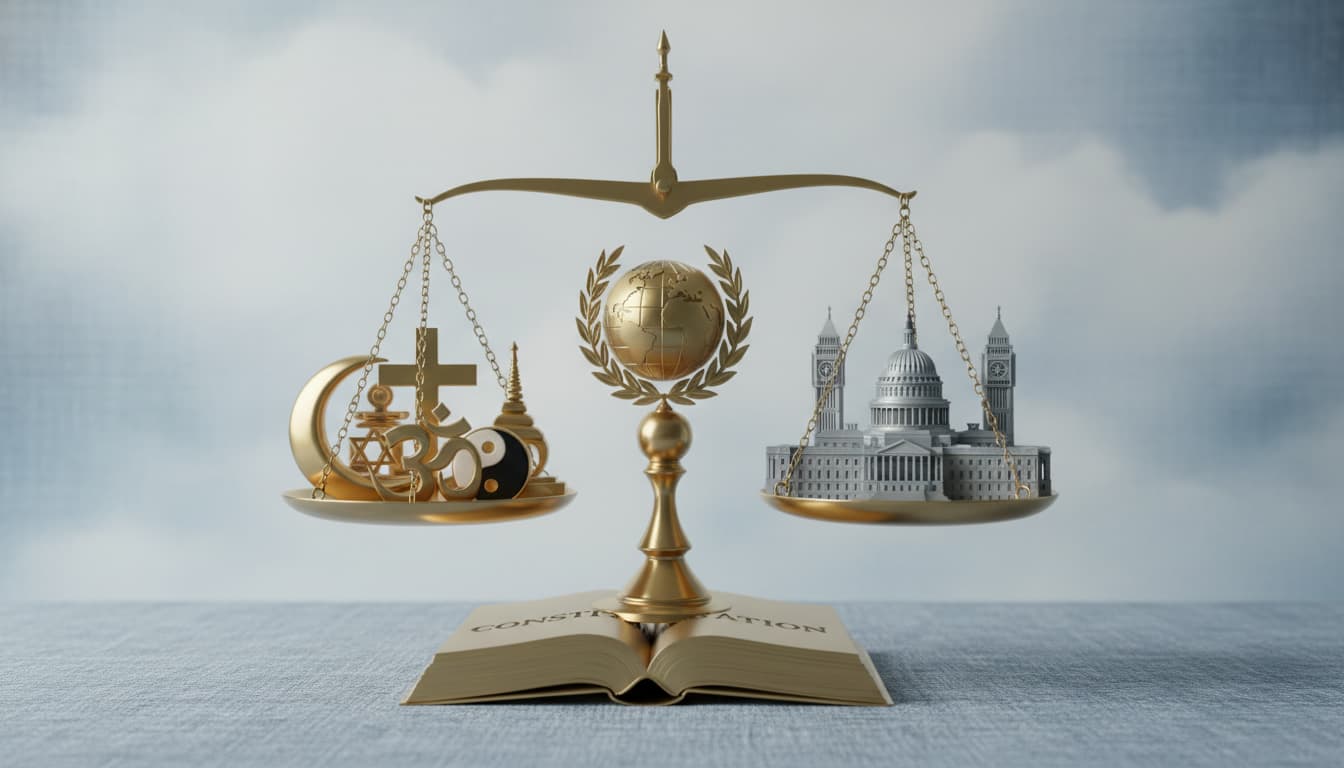

In brief, what you will discover in this article: a clear and simple definition of a secular country, its main characteristics, as well as concrete examples to better understand how secularism influences political and social life.
1. Understanding the Definition of a Secular Country
A secular country is a state where secularism is established as a fundamental principle. This means the state guarantees religious neutrality, meaning it does not favor any religion or spiritual belief. The principle of separation of church and state lies at the heart of this definition: public institutions do not depend on any religious organization, and beliefs must not influence political decisions.
Secularism also ensures freedom of conscience, allowing each citizen to believe or not believe, without discrimination. In practice, this translates into the absence of an official religion in the country, as well as the neutrality of public services and schools.
1.1 Characteristics of a Secular Country
To better grasp what a secular country is, here are the main characteristics:
- The state does not recognize, finance, or subsidize any religion.
- Laws guarantee equality for all citizens, regardless of their beliefs.
- The political sphere remains independent from religious influences.
- Freedom of conscience is protected, with strict respect for individual convictions.
- Public institutions adopt a neutral stance towards religions.
These elements form the foundation of secularism, which aims to preserve social peace and equality among all.
2. Examples of Secular Countries and Their Application
Several countries worldwide have enshrined secularism in their constitutions or laws. France is often cited as an emblematic example, where secularism has been a constitutional principle since 1958. It guarantees state neutrality and religious freedom while prohibiting public financing of religions.
Other countries, like Burkina Faso, also affirm their secular nature in their fundamental texts, thereby ensuring strict separation between religion and politics.
2.1 Secularism in France: A Recognized Model
Secularism in France rests on several laws that clearly define this principle. It protects freedom of conscience and enforces neutrality of public institutions. For example, public schools cannot display conspicuous religious symbols, and civil servants must remain impartial.
These rules ensure that religion does not disrupt public life or relationships between citizens.
3. Why is Secularism Important Today?
The stakes of secularism today are numerous. In a world where societies are increasingly diverse, secularism plays a key role to:
- Prevent conflicts related to religious differences.
- Ensure equal treatment of all citizens.
- Protect freedom of conscience against social or political pressures.
- Maintain neutrality of public institutions for a balanced democracy.
These objectives show that secularism is not just a legal concept but a true pillar for social cohesion.
4. How to Deepen Your Understanding?
To better understand the notion of a secular country, you can consult official and educational resources. For example, the government website vie-publique.fr offers a clear and accessible definition of secularism in France, focusing on its practical implications.
Moreover, for those interested in modern technologies and connectivity, understanding concepts like eSIM can also enrich your general knowledge. Discover for instance what an eSIM is to broaden your technological insights.
4.1 List of Key Points to Remember
- Secularism guarantees the religious neutrality of the state.
- It protects freedom of conscience and citizen equality.
- Separation between church and state is essential.
- France is an example of a secular country with precise laws.
- Secularism promotes social peace and democracy.
4.2 Steps to Deepen the Subject
- Read official and educational definitions.
- Study secularism laws in different countries.
- Observe how secularism is applied in daily life.
- Compare with other models of religion-state relations.
5. Secularism and Society: A Balance to Preserve
The role of secularism in society is to maintain a balance between personal convictions and the general interest. It allows everyone to live their faith or absence of faith freely, without infringing on others' rights.
This principle is all the more important in multicultural and pluralistic societies, where diversity of beliefs can be a source of richness but also of tensions.
6. Conclusion
In summary, a secular country is a state that guarantees religious neutrality, freedom of conscience, and separation between religion and politics. This fundamental principle promotes equality and social peace. To delve deeper into this topic, feel free to consult reliable resources such as Laïcité - Wikipédia or official French government fact sheets.
To go further, also discover how eSIM technology is revolutionizing mobile connectivity on Skyda.co, a reference site to stay connected worldwide.